

Se1Ep10 - Situating, Part 2

We'll say it again: Situating, Absorbing, Redirecting.
And there, we've said it again.
Like we said in the last episode, "in order to disagree, we first have to agree". What is it that we have to agree about? We have to agree what is the thing at dispute. This sounds pretty idiotic but the joke's on us: Many a time, we argue and fight when the matter at hand is not clear.
The result is a conflict that has no clear goal, other than to do the opposite of what the other does, which is a recipe for a disaster.
Now, the thing we DISAGREE about has roots in reality, in the Concrete. Our situating mission is to find these concrete roots and present them, making sure the other accepts them. The following are examples with suggested "solutions", not definite, not decisive, just suggestions.
Method 1 - Describe / Narrate
When conflict is immediate and tactical - like, say, a cookie on the table (the only thing really worth fighting for...), then we need to concrete, and simply describe what's at hand:
"There is one cookie on the table, and we both want it".
This can also apply for bigger and heavier matters, for example, I am a doctor, and I want to tell a patient that their life-style is ruinous. I then proceed to describe said lifestyle, but, here's a tip: If I describe my patient, It will be "You are this" and "You are that", and people have sensitive ears when it comes to the word "you". We can use a general description that does not use any personal prepositions, and luckily enough, since it's only the two of us in the room, the patient will know who are talking about:
"Okay, so let's see what we have here: One pack of cigarettes a day, some recreational substances here and there... Alchohol, and no physical activity..."
Yes, it still sounds bad. But that is because the situation is bad. The facts here, even when delivered dry, are not fun to hear. So we can try a more vague approach. We just need to remember that people don't like being in the wrong, and if we are too nice, and deliver watered-down facts, we may avoid conflict, but give our "opponent" a chance to persuade themselves that we're not talking about them, or that it's not too bad... Food for thought.
Playing around with the 3 spaces is also helpful in finding our facts. For example, if we are arguing and we want somebody to stop shouting, our situating can be:
"You are shouting at me"
This is very straightforward, but we define for the other how they talk, which they can deny ("I'm not shouting!!!!"), and we also define for them that they are aggressive, since we are telling them they are aiming their shouting at us. So we play in their space (defining their aggression) in the common space (defining shouting) and in ours. But we can make simpler by sraying only in our space, where it's legitimate for us to decide what we like and what not:
"This is really loud for me..."
"This" refers to the other's speech, without labeling it, and the problem is mine and mine alone.
Method 2 - WhyWhyWhyWhy...
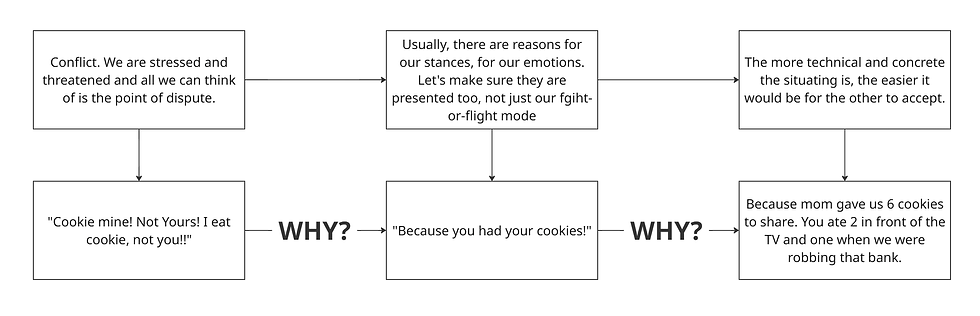
"Hey! Mom gave us 6 cookies to share. You ate 3... (now absorb) maybe I didn't count right, but I think this one's mine."
Have an elaborate thought process others don't understand and reject? Asserting our superior intellect (not always available...) or saying "trust me" is not always enough...

"Trust me. The real mother will be found!"
WHY?
"Because she will jump and vualenteer to give it up"
WHY?
"Because she'd rather lose the baby than harm him"
WHY?
"Because a mother's love is so deep, that she will renounce any claim, just to see her baby safe"
And so, in reverse: (Situate) "Look, Turban-Guy. A mother's love is the deepest love there is. A mother will renounce any claim just to see her baby safe. The real mother will rather lose the baby than harm him. She will come forward and give him up." (Absorb) So I know this seems a little crazy (Redirect) but you can be sure we won't get anywhere near cuttign the baby.

Comments